5 Signs Your Dog Is Bored and Exactly
What to Do About It
Your dog chewed through your favourite pair of chappals. Again. Or they've been barking at the wall for the last 20 minutes. Or they follow you into the bathroom every single time, standing outside the door with that expression that says I am not okay with this arrangement.
Here's the thing: none of this is bad behaviour. It is communication. Your dog is telling you, in the only language available to them, that something is missing — and that something is almost always mental or physical stimulation. The good news is that once you can read the signs, fixing them is genuinely straightforward.
🐶 Is Your Dog Bored? Quick Check
Tick any that sound familiar in the last week:
🐾 The 5 Signs — And What Fixes Each One
- Destructive chewing → redirect with the right texture
- Late-night zoomies & restless energy → burn it through tug play
- Clinginess & following you everywhere → give them an independent task
- Digging, pacing, can't settle → nose work. Seriously.
- Attention-seeking barking & whining → the squeaky toy solution
Your Dog Is Chewing Everything 🦷
Shoes. Chair legs. The corner of your laptop charger. If your dog has recently discovered a new love for destruction, they haven't turned evil. They've turned bored.
Chewing is one of the most natural, hardwired behaviours in dogs. It releases endorphins, relieves jaw tension, and — critically — it gives their brain something to focus on. A dog with enough mental and physical stimulation rarely chews things they shouldn't. A dog left alone with nothing to do will eventually find something, and it will almost always be something you valued.
The fix isn't punishment. Punishment after the fact does nothing — dogs don't connect consequences to actions that happened more than a few seconds ago. The fix is redirection: give them something appropriate to chew that satisfies the same instinct, and make it more rewarding than your furniture.
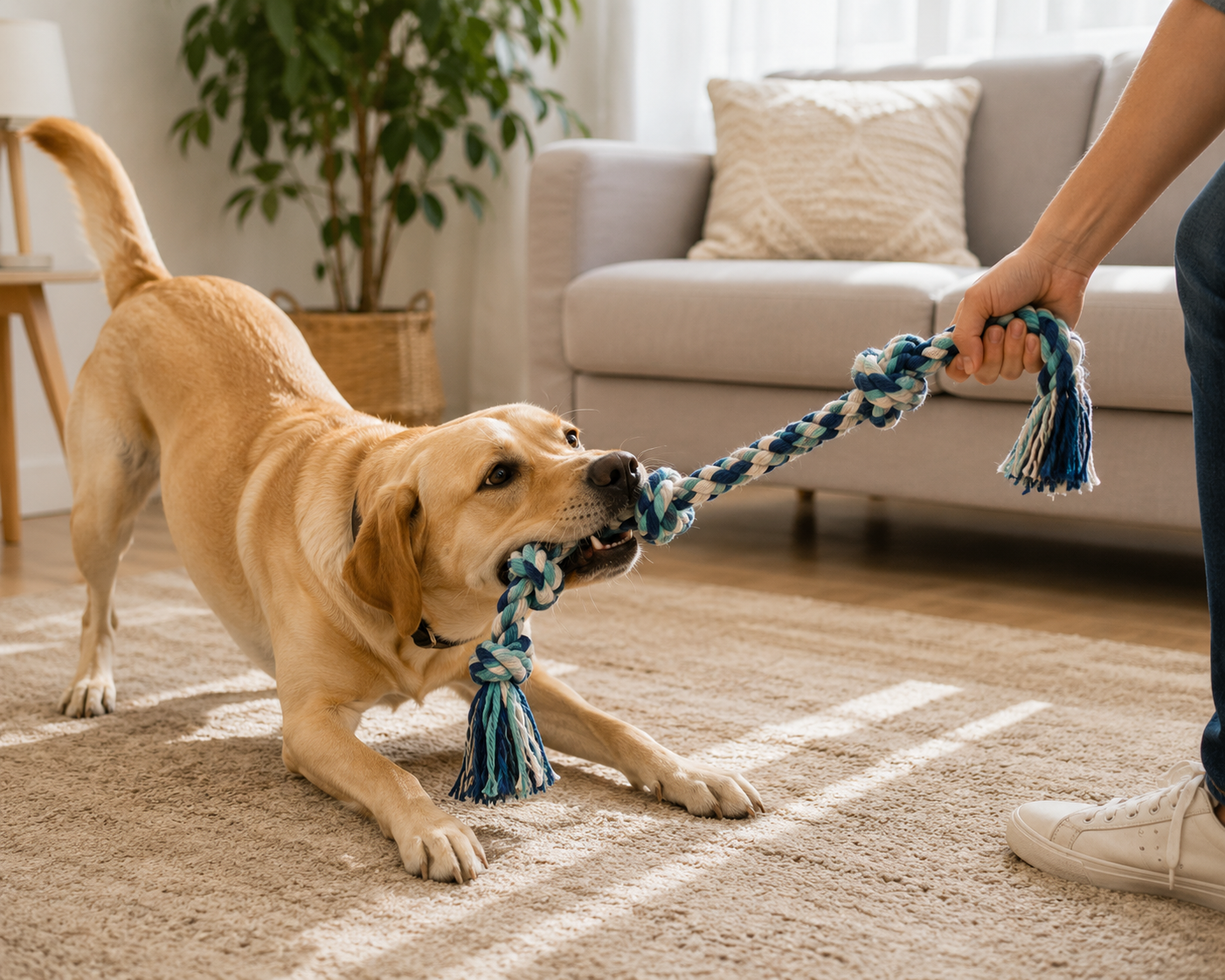
A heavy-duty cotton rope toy built for aggressive chewers, interactive tug games, and active training sessions. The multi-strand cotton satisfies the chewing instinct without destroying in minutes.
See on Amazon 🦷Cotton rope toys work for destructive chewers specifically because the texture engages the jaw in a way that smooth rubber or plastic doesn't. The fibres separate as the dog chews, which keeps the experience interesting and mimics the sensation of working through something resistant — exactly what a bored chewer is seeking. This is a product India's dog parents have been trusting for good reason.
When you catch your dog chewing something wrong, don't shout — calmly swap it for the rope toy and reward them when they engage with it. Three or four consistent redirections and they'll start going for the rope first.
The 11pm Zoomies Are Real 🌙
Your dog was calm all day. Then 10:30pm arrived and they transformed into a completely different animal — sprinting laps around the sofa, bouncing off walls, absolutely feral. This is not random. This is stored energy looking for an exit.
Dogs have what behaviourists call a Frenetic Random Activity Period — FRAPs, or zoomies. They happen when pent-up energy that hasn't been discharged through play or exercise finally forces its way out. Evening zoomies specifically are a reliable signal that the day didn't offer enough physical engagement. Your dog is not hyper by nature. They are under-stimulated by circumstance.
Dogs need both physical exertion and active play to discharge energy fully. A walk alone often isn't enough — particularly for working breeds (Labradors, Beagles, German Shepherds) who were bred for sustained activity. Interactive tug play uses more muscle groups and burns more energy per minute than leash walking.
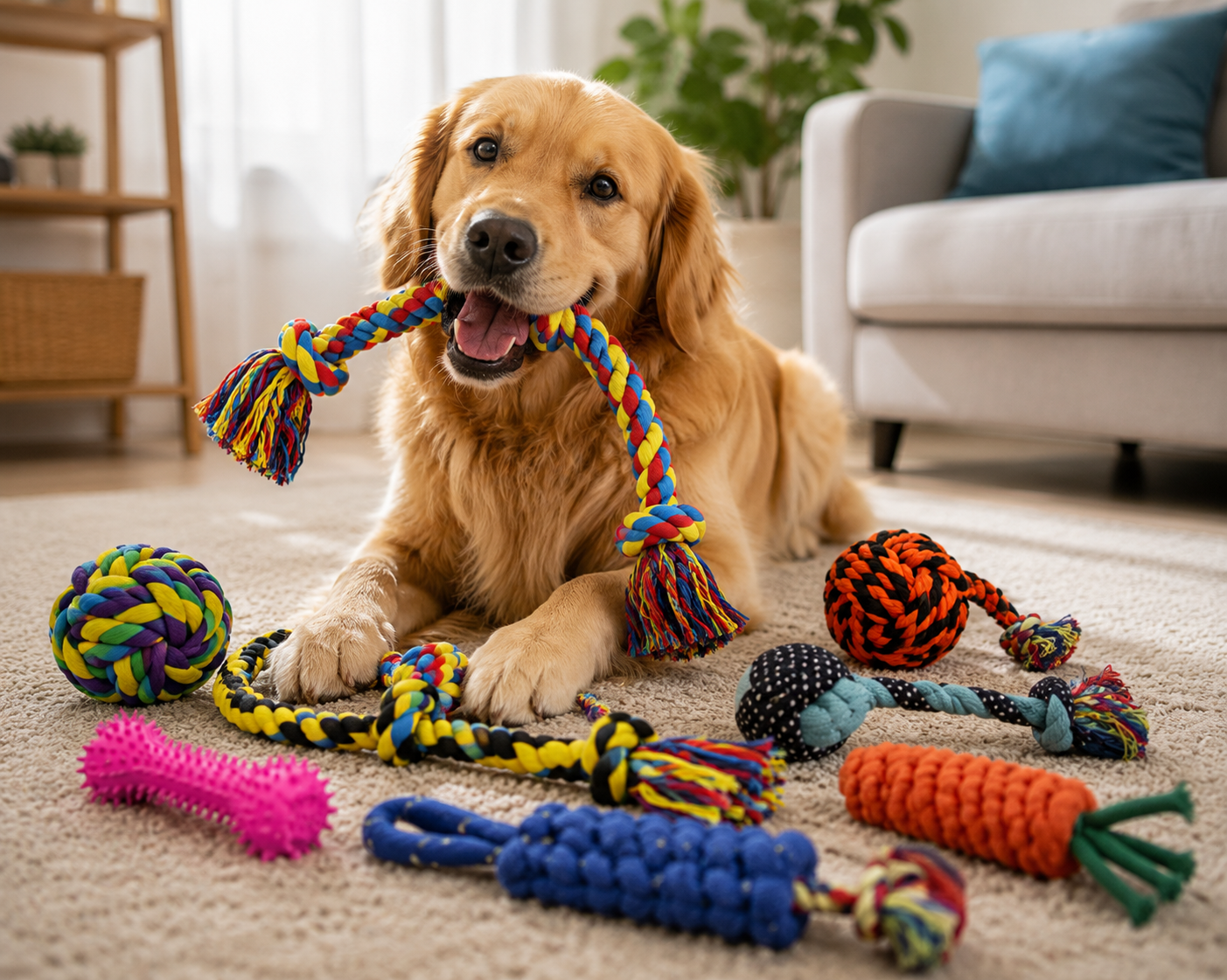
A vibrant rope toy bundle perfect for tug-of-war, chewing, training, and active play sessions. Multiple shapes and textures mean your dog stays interested — and tired.
See on Amazon 🎨A dedicated 10-minute tug session before dinner — not before bed, before dinner — is enough to meaningfully reduce evening zoomie intensity in most dogs. Tug play is interactive, requires full-body engagement, and the resistance element tires muscles faster than fetch. The variety in a rope set matters: rotating between different shapes keeps the play session novel and maintains your dog's attention for longer.
They Follow You Everywhere 👣
The bathroom. The kitchen. Into the next room for five seconds. Your dog is your shadow — and while it's flattering at first, constant clinginess is actually a sign of anxiety born from under-stimulation.
A dog with enough to do doesn't need to follow you everywhere because they have their own agenda. Clinginess develops when your dog has no independent source of engagement — no task, no toy that holds their attention, nothing to do except wait for you to do something interesting. You become their entire entertainment system, and the moment you move, they move.
The solution is to give them something absorbing enough to occupy their brain independently — ideally something that involves food, because food motivation is the most reliable engagement tool in a dog's world. A treat dispenser toy does exactly this: it turns your absence into an opportunity rather than a loss.

A freezer-friendly interactive chew toy that dispenses treats slowly, keeping dogs mentally stimulated and happily occupied — without you having to be in the room.
See on Amazon 🧊The frozen element is what makes this particularly effective. A frozen treat dispenser takes significantly longer to work through than a room-temperature one — anywhere from 20 minutes to over an hour depending on what you fill it with and how hard you freeze it. That's 20 to 60 minutes of your dog fully absorbed in a task, not looking for you. Do this consistently before you need to focus, and the clingy pattern starts to break within a week.
Fill with a mix of peanut butter (xylitol-free), banana, or plain curd and freeze overnight. The next morning you have an hour of independent dog entertainment ready to go. Make 3–4 at a time and rotate from the freezer.
Pacing, Digging, Can't Settle 🐾
Your dog paces from room to room. They scratch at the floor or the door. They circle, lie down for 30 seconds, get up, repeat. This isn't anxiety medication territory — it's a dog whose nose hasn't been used today.
Dogs have roughly 300 million olfactory receptors compared to a human's 6 million. Their nose is their primary sense — it's how they read the world, assess their environment, and process information. When a dog's nose isn't engaged, a fundamental part of their brain sits idle. That idle energy manifests as restlessness, pacing, and displacement behaviours like digging.
Research in canine enrichment consistently shows that 15–20 minutes of nose work — sniffing, foraging, scent games — produces the same mental fatigue as 45–60 minutes of physical exercise. It's the most efficient boredom solution available, and the most underused by Indian dog parents.
A mentally stimulating snuffle mat that encourages natural foraging instincts, slow feeding, and nose work. Scatter kibble into it and watch your dog transform into a focused, calm problem-solver.
See on Amazon 🌿The reason this one works is simple: it works on almost every dog, immediately, with no training required. Scatter some kibble or small treats into the mat's fabric folds, put it down, and step back. Within seconds your dog's nose is working, their brain is engaged, and the pacing stops. By the time they've found every piece of food, they are genuinely tired — the good, settled kind of tired that lasts.
The Barking That Makes No Sense 📣
Not alert barking. Not territorial barking. Just barking — at you, at nothing, at the general concept of silence. Paired with pawing, nudging, or dropping things at your feet. This is attention-seeking, and it escalates until it gets a response.
Attention-seeking behaviour is a feedback loop. Your dog barks. You look up, tell them to stop, maybe get up to check on them. They got your attention. The barking worked. Inadvertent reinforcement is how most attention-seeking behaviours become habits — not because the dog is manipulative, but because they found a strategy that reliably produces a response from you.
Breaking the loop requires two things: not rewarding the barking with attention, and giving your dog a legitimate outlet for their need to interact. A squeaky toy does the second part well — it gives them sound, movement, and tactile engagement that partially replicates the interaction they're seeking from you, without requiring your participation.

A soft kettlebell-shaped squeaky toy that keeps dogs entertained with chewing, cuddling, and playful indoor fun. The squeak gives them a response that doesn't require you to be involved.
See on Amazon 🏋️The kettlebell shape is genuinely clever — irregular enough to be unpredictable when thrown or dropped, which keeps a dog's interest longer than a standard ball. The squeak provides auditory feedback that many dogs find inherently rewarding: they squeaked it, something happened, they want to squeak it again. That loop keeps them occupied and, critically, quiet.
When your dog starts attention-barking, don't make eye contact — calmly redirect them to the squeaky toy. The moment they engage with it, give quiet praise. You're teaching them that the toy gets a better response than barking does. It takes consistency, but it works within a week or two.
🐾 The Bigger Picture
Every behaviour in this list is your dog trying to tell you something. They're not being difficult, defiant, or dramatic — they're understimulated, and they're using the only communication tools they have. Once you learn to read the signs, the fixes are genuinely simple: redirect destructive energy, burn physical energy before it peaks, give them tasks to do independently, engage their nose, and give attention-seeking behaviour a legitimate outlet.
You don't need all five products. Match the solution to the sign you're actually seeing. Start with one, be consistent for a week, and watch how quickly a bored dog becomes a settled one.
A tired dog — mentally and physically — is a happy dog. And a happy dog is a much better housemate.
🐶 More Dog Finds
We handpick toys, gear, and enrichment products for Indian dogs — so you don't have to scroll Amazon for hours.
Browse All Dog Finds